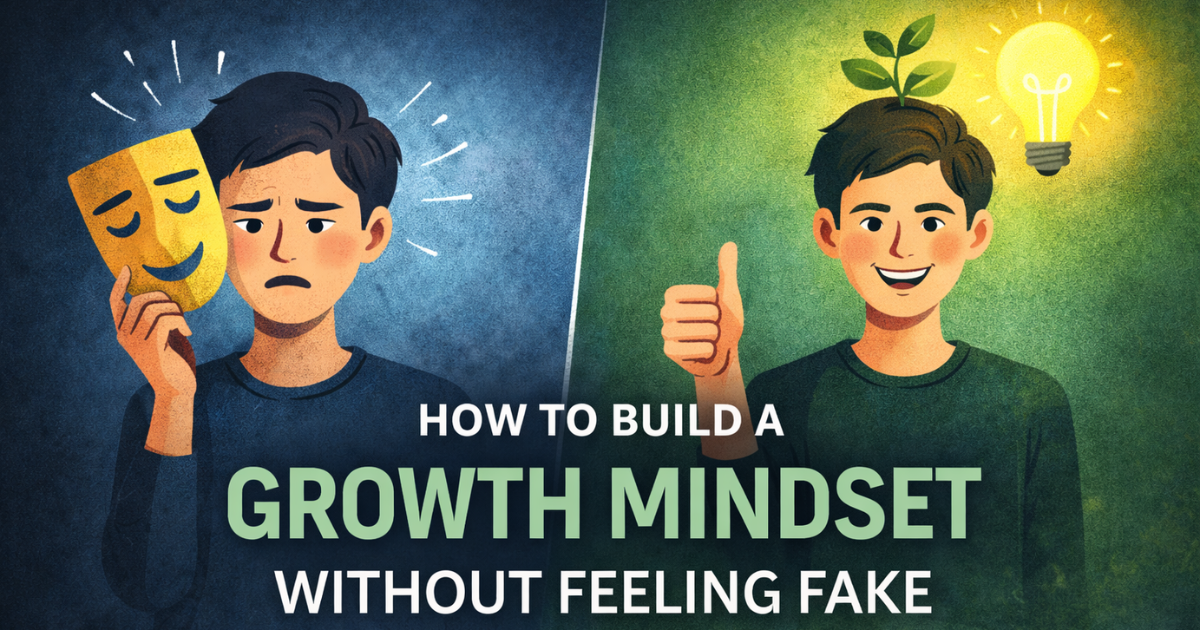
How to Build a Growth Mindset Without Feeling Fake
How to Build a Growth Mindset Without Feeling Fake
“Just think positive.”
“Believe in yourself.”
“Tell yourself you can do anything.”
If you’ve ever tried these ideas and felt fake, forced, or even worse, you’re not alone.
A growth mindset isn’t about pretending everything is fine or lying to yourself. It’s about changing how you relate to challenges, effort, and failure — in a way that feels honest and sustainable.
In this article, you’ll learn how to build a real growth mindset, without fake affirmations, toxic positivity, or pressure to feel motivated all the time.
What a Growth Mindset Actually Means (No Buzzwords)
A growth mindset doesn’t mean:
- Always feeling confident
- Being positive 24/7
- Ignoring doubt or fear
It simply means this:
Believing that skills, intelligence, and confidence can be developed through effort and learning.
People with a growth mindset still struggle.
They still fail.
They still doubt themselves.
The difference is how they interpret those moments.
Why “Fake Positivity” Backfires
Many people quit self-improvement because it feels dishonest.
Here’s why fake positivity doesn’t work:
- Your brain detects lies quickly
- Forced affirmations create resistance
- Ignoring problems makes them louder
Saying “I’m amazing” when you don’t believe it creates internal conflict.
Real growth comes from truth + direction, not denial.
Step 1: Replace Fake Affirmations With Honest Reframes
Instead of lying to yourself, reframe the truth.
❌ Fake:
“I’m confident and fearless.”
✅ Honest:
“I’m nervous, but I can learn to handle this.”
❌ Fake:
“I never fail.”
✅ Honest:
“Failure is feedback, not a verdict.”
Growth mindset starts when your inner dialogue becomes realistic but forward-focused.
Step 2: Focus on Process, Not Personality
A fixed mindset sounds like this:
- “I’m not smart enough”
- “I’m bad at this”
- “That’s just who I am”
A growth mindset shifts the focus:
- “I haven’t learned this yet”
- “I need a better system”
- “This skill takes practice”
You’re not broken.
You’re unfinished.
Step 3: Normalize Struggle Instead of Avoiding It
One of the biggest mindset shifts is understanding this:
Struggle is not a sign of failure — it’s a sign of growth.
If something feels hard:
- Your brain is learning
- New connections are forming
- You’re expanding capacity
Avoiding discomfort keeps you stuck.
Facing it calmly moves you forward.
Step 4: Track Effort, Not Just Results
Most people only feel successful when results appear.
That’s dangerous.
Instead, measure:
- Did I show up?
- Did I try?
- Did I learn something?
Results lag behind effort.
Effort builds identity.
Over time, you stop asking:
“Am I good at this?”
And start thinking:
“I’m someone who practices.”
Step 5: Use Language That Leaves Room to Grow
Small language shifts make a big difference.
Replace:
- “I can’t do this”
with: - “I can’t do this yet”
Replace:
- “I failed”
with: - “This attempt didn’t work”
Words shape interpretation.
Interpretation shapes mindset.
Step 6: Stop Comparing Your Beginning to Someone Else’s Middle
Comparison destroys growth mindset faster than failure.
What you see online is:
- Edited outcomes
- Years of practice hidden
- Failures removed
Growth is private, slow, and uneven.
Your only real comparison:
Who you were yesterday.
Step 7: Build Identity Through Small Proof
You don’t need confidence first.
You need evidence.
Start small:
- One focused session
- One attempt
- One habit
Each action becomes proof:
“I’m someone who tries.”
“I’m someone who learns.”
Identity changes through action — not motivation.
Why a Real Growth Mindset Feels Calm, Not Loud
A fake mindset screams:
- “I must succeed now!”
- “I can’t fail!”
A real growth mindset whispers:
- “I’ll figure this out.”
- “This is part of the process.”
It feels quiet, grounded, and steady.
That’s how you know it’s real.
Final Thoughts: Growth Without Pretending
You don’t need:
- Fake confidence
- Loud affirmations
- Constant positivity
You need:
- Honest self-talk
- Consistent effort
- Patience with yourself
A growth mindset isn’t about becoming someone else.
It’s about becoming better — realistically.
👉 Want simple systems to grow without burnout?
Visit https://nextlevelroutine.com
and build progress that actually feels real.