The Proven Truth: Why Discipline Wins When Motivation Fails
Why Motivation Fades ?
Motivation feels powerful. It gives you energy, excitement, and the feeling that this time will be different. It’s what pushes people to start new routines, set ambitious goals, and promise themselves a better future.
But if motivation were enough, everyone would already be where they want to be.
The truth is simple: motivation fades, and discipline wins long term. Understanding why this happens—and how to use it to your advantage—can completely change how you approach habits, productivity, and personal growth.
The Problem With Relying on Motivation
Motivation is emotional.
It depends on mood, energy, inspiration, and external circumstances.
One good video, book, or quote can make you feel unstoppable. But that feeling doesn’t last.
Here’s why motivation alone fails:
- It’s inconsistent
- It depends on how you feel
- It disappears under stress or fatigue
- It’s unreliable during hard days
Motivation is great for starting, but terrible for sustaining progress.
Why Motivation Fades
Motivation fades because your brain is designed to seek comfort, not growth.
When something is new, exciting, or emotionally charged, your brain releases dopamine. That’s the motivation phase. But as soon as the task becomes repetitive or challenging, dopamine drops.
This is why:
- New habits feel exciting at first
- Progress slows down after a few days or weeks
- Resistance increases
- You start looking for shortcuts or excuses
It’s not a personal failure. It’s biology.
The Motivation Trap
Many people fall into the same cycle:
- Feel motivated
- Start strong
- Miss a day
- Feel discouraged
- Quit
- Wait for motivation again
This loop keeps people stuck.
Waiting for motivation means giving control of your life to your emotions.
What Discipline Really Is (And Isn’t)
Discipline is often misunderstood.
Discipline is not:
- Being harsh on yourself
- Forcing willpower all day
- Being perfect
Discipline is:
- Doing what matters even when you don’t feel like it
- Following systems instead of moods
- Making progress predictable
Discipline removes the need for motivation.
Why Discipline Wins Long Term
Discipline works because it’s system-based, not emotion-based.
When you rely on discipline:
- Action becomes automatic
- Decisions become easier
- Consistency increases
- Progress compounds
You don’t ask, “Do I feel like doing this?”
You ask, “Is this what I planned?”
That one shift changes everything.
Discipline Creates Momentum
Small disciplined actions build momentum.
A short walk every day beats one intense workout once a week.
Writing 300 words daily beats waiting for inspiration to write 2,000 words.
Discipline focuses on showing up, not on intensity.
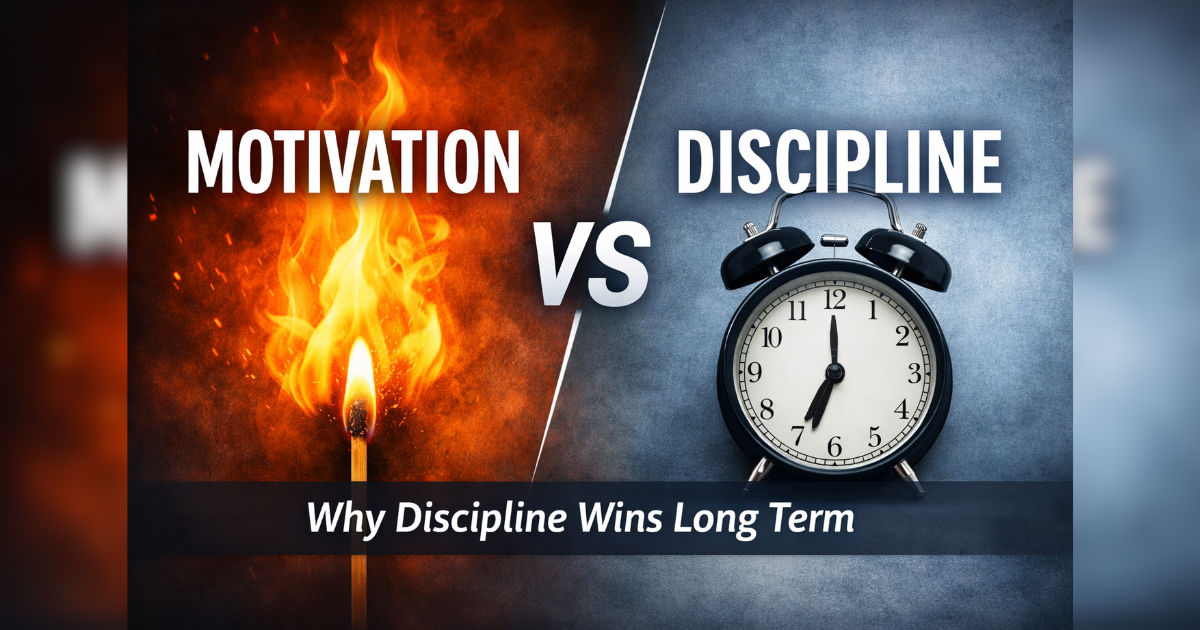
Motivation vs Discipline: A Simple Comparison
| Motivation | Discipline |
|---|---|
| Emotional | Systematic |
| Short-term | Long-term |
| Inconsistent | Reliable |
| Dependent on mood | Independent of mood |
| Starts actions | Sustains actions |
Motivation gets you started.
Discipline keeps you going.
How Discipline Replaces Motivation
The goal isn’t to eliminate motivation—it’s to stop depending on it.
Here’s how discipline takes over:
- You create a simple routine
- You reduce friction
- You decide in advance
- You repeat the behavior
- The habit becomes automatic
At that point, motivation becomes optional.
The Role of Systems Over Willpower
Willpower is limited.
Systems are not.
Discipline works best when supported by systems:
- Fixed schedules
- Clear routines
- Time blocking
- Habit tracking
- Environment design
When the system is clear, action requires less effort.
Why Discipline Feels Hard at First
Discipline feels hard in the beginning because:
- You’re building a new identity
- The habit isn’t automatic yet
- Your brain resists change
But over time, discipline becomes easier than starting over again.
Discipline Builds Self-Trust
Every time you do what you said you would do, you build trust with yourself.
That self-trust:
- Increases confidence
- Reduces self-doubt
- Makes future habits easier
Motivation gives a temporary high.
Discipline builds lasting confidence.
How to Build Discipline (Practically)
Start small:
- One habit
- One routine
- One daily commitment
Make it easy:
- Reduce steps
- Remove distractions
- Set clear time blocks
Track consistency, not perfection.
Discipline grows through repetition.
Final Thoughts
Motivation is a spark.
Discipline is the engine.
If you rely on motivation, progress will always be unstable.
If you build discipline, progress becomes inevitable.
You don’t need to feel ready.
You need a system.
That’s how real change happens.
🔗 Continue Building Better Systems
If you want practical routines, habit systems, and discipline-based strategies, explore more here: